

A simple concept often highlighted in investment discussions is the impact of starting early.
Even small, consistent contributions made early in life can create a meaningful head start by the time someone enters the workforce.
Over a lifetime, the difference this creates is far greater than most people expect.
A $30,000 head start.
Or $0.
Same person.
Same salary.
Same contribution rate.
Same assumed return.
The only difference is time.
The comparison
The key variable in this scenario is the starting balance.
Nothing else changes.
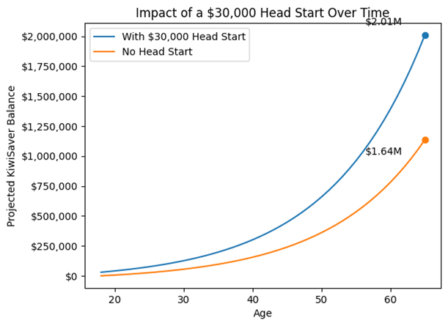
Scenario A: $30,000 head start
By age 65, the projected balance is approximately $2.01 million.
Scenario B: starting from $0
By age 65, the projected balance is approximately $1.64 million.
Assumptions
Two individuals are modelled starting work at age 18:
The difference
This results in a gap of approximately $471,000.
There is:
The outcome is driven purely by time.
Nearly half a million dollars of additional wealth comes from money invested before the individual even begins earning.
Why this matters
Compounding rarely feels significant in the early years. Growth tends to appear steady and relatively modest.
Over longer timeframes, however, the impact becomes substantial.
Starting earlier allows:
In many cases, wealth creation begins well before someone earns their first income. One of the most powerful advantages in investing is simply getting started earlier than most.
KiwiSaver changes: why reviewing your contributions matters now
From 1 April 2026, KiwiSaver contribution rates are increasing from 3% to 3.5% for both employees and employers, with a further increase to 4% already signalled for 2028.
For many people, this change will happen automatically through payroll, meaning slightly less take-home pay but more going into long-term savings each pay cycle.
While the increase may seem small, even a 0.5% uplift can make a meaningful difference over time as those additional contributions begin compounding.
This makes it a timely opportunity to review your KiwiSaver investment. A contribution increase alone does not guarantee better outcomes, your fund choice, risk level, and overall strategy still play a key role in how your balance grows over time.
Assumptions used in these projections
These figures are illustrative only and designed to demonstrate the long-term impact of starting earlier.
If you would like to understand how your KiwiSaver investment is tracking, or explore strategies to make the most of these upcoming changes, contact us through the form below to speak with an adviser.
You can also watch our KiwiSaver Webinar, which explores practical ways to improve long-term investment outcomes.
Please fill in the form below with your contact details and one of our advisers will get in touch in 24 hours. "*" indicates required fields
Wherever you are on your investment journey, we can help.